
Nos réalisations
Critiques

THE GLOBE AND MAIL
A Quebec paediatrician’s explosive charge
By Margaret Wente
Ontario, Saturday, april 22, 2006
MAMAN MALIGNE
Une gifle soufflée d'Outre-Atlantique
Par Maman maligne
Suisse, 2006
LIVRE: LE BÉBÉ ET L'EAU DU BAIN
Photo Quebec-Amérque: Chicoine & Collard, 2006
LE BÉBÉ ET L'EAU DU BAIN
THE GLOBE AND MAIL
The baby and the bathwater: A Quebec paediatrician’s explosive charge
By Margaret Wente, journaliste
Ontario, Saturday, april 22, 2006
Every parent in Quebec knows Jean-François Chicoine. His regular media appearances have made him the best-known paediatrician in the province. Le bon Dr Chicoine, as they call him, is the baby doctor people trust.
But nom, the personable young paediatrician has unleashed a bombshell – a 520-page indictment of social practices that he believes are harmful to our kids. His most explosive charge: Too many parents parachute their kids into daycare at far too young an age.
His book, co-authored by well-known journalist Nathalie Collard, is called Le bébé et l’eau du bain (The Baby and the Bathwater). “In Québec’, he writes, “children are kept in daycare 52 weeks a year, about 60 hours a week… Children learn to say the word “mommy” without being cuddled by their mother and nobody seems bothered by that”.
Challenging daycare in Quebec is like challenging a way of life. Universal daycare is a cornerstone of social policy. There are 51,000 children in care under the age of 2, and almost every neighbourhood boasts a Centre de la petite enfance.
Only one agenda: kids
The subject is politically explosive not only in Quebec, but across the country. Daycare activists and federal Liberals are arguing passionately that Ottawa should fund something like the Quebec model across the country. They’re deeply worried that people like Dr Chicoine will whip up a backlash that will undermine the case for public daycare and drive mothers back into the home.
Dr Chicoine insists he’s not political. He has only one agenda: kids. And he ardently believes that the best place to be for most kids under 2 is with their parents. “At this time of life, it is very important for the baby to get a lot of affection and form a sense of security, “he told me. That is the basis for intelligence, future behaviour and a lot of others things.”
To “fall in love”
His conclusions are based on a large body of recent research about attachment theory, as well as 20 years of personal observation. “Between birth and eight months, the child will attach to the world, and the mother or father will attach to their baby,” he says. Those eight months are just as crucial for the parent as for the baby. Forget maternal instinct. Parents need time, he says, to “fall in love”.
Between eight and 15 months, the baby will gradually be able to trust people other than the primary caregiver – but no more than five at the most. Now look at daycare. “In daycare, a baby will encounter an average of 17 different caregivers between those ages”, says Dr Chicoine. “During the summer, it’s five of six a day”. For a child so young, having to deal with so many strangers is an unsettling, even terrifying, experience.
Sleep problems, feeding problems, and behaviour problems are typical short-term results of attachment disorder. But Dr. Chicoine is convinced the consequences can be more serious and long-lasting. Children may develop learning disorders and have trouble in school. They may turn into troubles adolescents. Their ability to trust their parents may be permanently impaired.
Not all children will suffer all these adverse effects. In fact, most won’t. If they have good parents, chances are they’ll be fine. But a significant minority – one in four, at a rough guess – “will be lost”.
Interestingly, Dr. Chicoine believes that the families who rely on daycare the most are in fact the ones who are at greatest risk. These are the blue-collar families who work long hours and struggle to get by on tow meagre incomes. The mother has no choice but to go back to work quickly – usually to a menial job she doesn’t like. The child spends long hours in care that is often “mediocre, even pathetic” – and both mom and baby are constantly stressed out.
Dr. Chicoine argues that feminists have done these women a significant disservice. What they really need is not daycare for their one-year-olds. What they need is a way to stay home. He sees a massive disconnect between feminist daycare advocates – who tend to be highly educated career women – and your average high-school-graduate mom, who has a job, not a career, and works because she must. “These women are getting screwed by having to return to work too early”, he says bluntly.
Attachment theory
Attachment theory isn’t popular among feminists, because it raises extremely uncomfortable questions about the compatibility (or not) of careers and motherhood. As Ms Collard, Dr. Chicoine’s co-author, puts it, “Today, when your have a baby, you’re supposed to tell the world that nothing’s changed. You’re just as productive and just as thin as before. You spend a lot of energy saying nothing has changed… But if you put a baby into daycare at two months old, why have a baby at all? It’s as if staying at home with your child were a punishment.
In case you think Dr. Chicoine hates daycare, he doesn’t. In fact, he thinks we need to invest in it more, and especially in improving the quality of daycare workers. He believes that infant daycare – very high-quality infant daycare, unlike the quality on offer today – can be of real benefit to children from seriously deprived backgrounds and other high – needs kids. He also thinks daycare (in moderation) is fine for kids over 2 or 2 ½ who are old enough to benefit from the socialization it offers.
I don’t think it’s a matter of fear or guilt
Since its publication three weeks ago, Dr. Chicoine’s bombshell has become a bestseller in Quebec. It is being hotly debated on every talk show. No wonder. He has taken on an institution in which Quebeckers have invested a great deal of pride. He has also tackled the taboo subjects of class and status, and the divergent interests of working-class and professional women. And he has loaded on the guilt. Not that working mothers need any more of that.
So how does he respond to the guilty mom (or dad) who reads his book, and can’t figure out how she (or he) can possibly stay home for two whole years of baby’s life?
“If she asks the question, then we’ve succeeded,” he says. “I want her to think. It’s her right to think. I don’t think it’s a matter of fear or guilt. It’s the beginning of responsibility”.
He believes it’s our responsibility, too. “We need a lot of intense public debate, because we have some important choices to make”.
MAMAN MALIGNE
Une gifle soufflée d'Outre-Atlantique
Par Maman maligne
Suisse, 2006
Et vlan! Une gifle soufflée d'Outre-Atlantique. C'est cette fois du Canada que nous vient cet ouvrage fort bien documenté qui attaque à la force de la réflexion la vache sacrée des féministes: la garde déléguée des enfants, et plus particulièrement la garderie avant l'âge de 2 ans.
Dans un pays qui offre 12 mois de congé parental, il fallait oser! Diable, que nous sommes loin en Suisse de ces pensées-là: des cours d'attachement au lieu ou en complément des cours de préparation à la naissance qui de fait ne couvrent que l'accouchement, une politique familiale d'entreprise qui ferait de l'enfant une valeur partagée de la société, etc...
Fait frémir
Un livre bien sûr qui fait frémir si, comme moi, on est scotché de voir étalé là ce qu'on ressent profondément...
Petit extrait:
" De toutes les analyses du NICHD (National Institute of Child and Human Development, américain), la plus éclairante est celle-ci: non seulement la qualité de la garde non parentale importe, mais c'est la durée des soins prodigués à l'enfant hors de sa famille qui va avoir des effets sur l'ensemble de son développement. (...) Ainsi, si, sur le plan social, les effets d'une garde non parentale ne sont pas trop évidents avant l'âge de deux ou trois ans, dès l'âge de quatre ans les effets cumulatifs de la garde non parentale se traduisent par différents problèmes comportementaux se poursuivant à la maternelle et en première année. Cette affirmation demeure vérifiable indépendamment de la qualité des services de garde. Les styles et patrons d'interaction mère-enfant se font moins harmonieusement, simplement en fonction du temps que l'enfant passe sans sa maman, surtout si la qualité éducative n'y est pas."
Donner, donner, donner
Remettre les besoins de l'enfant, et son attachement à ses parents qui est le principal aspect de ces besoins au centre de tout. En faire une priorité, pour transformer la société et la rendre plus saine. Comment se débarrasser des déséquilibres de celui qu'on nommait autrefois l'enfant-tyran, devenu entre-temps hyperactif ou troublé du comportement? Ce livre y répond ainsi: donner, donner, donner: de soi, de son temps, de son énergie de parents, sans compter, pendant la période où l'enfant construit 95% de ce qu'il sera toute sa vie. Soit, idéalement, pendant trois ans.
Et en attendant que cette révolution ait lieu cet ouvrage de référence pour le parent investi fournit de précieux conseils pour minimiser les risques, atténuer au mieux les inévitables déchirements liés à notre vie contemporaine.
Un pavé de 500 pages qui se digère mieux que le dernier Dantec, même s'il est à ranger au même rayon, celui de la science-fiction, dans notre beau pays...
A suivre.
FICHE TECHNIQUE " LE BÉBÉ ET L'EAU DU BAIN"
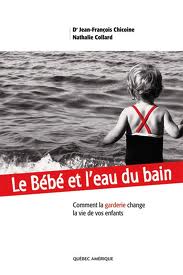
LE BÉBÉ ET L’EAU DU BAIN : COMMENT LA GARDERIE CHANGE LA VIE DE VOS ENFANTS —Jean-François Chicoine, pédiatre et Nathalie Collard, éditorialiste (Auteurs) —Rémi Baril (Direction de projet) —Anne-Marie Villeneuve(Éditrice) —Éditions Québec Amérique, Montréal, Québec, Canada (Édition) 2006, ISBN : 978-2-7644-0479-9 (2-7644-0479-4), 513 pages